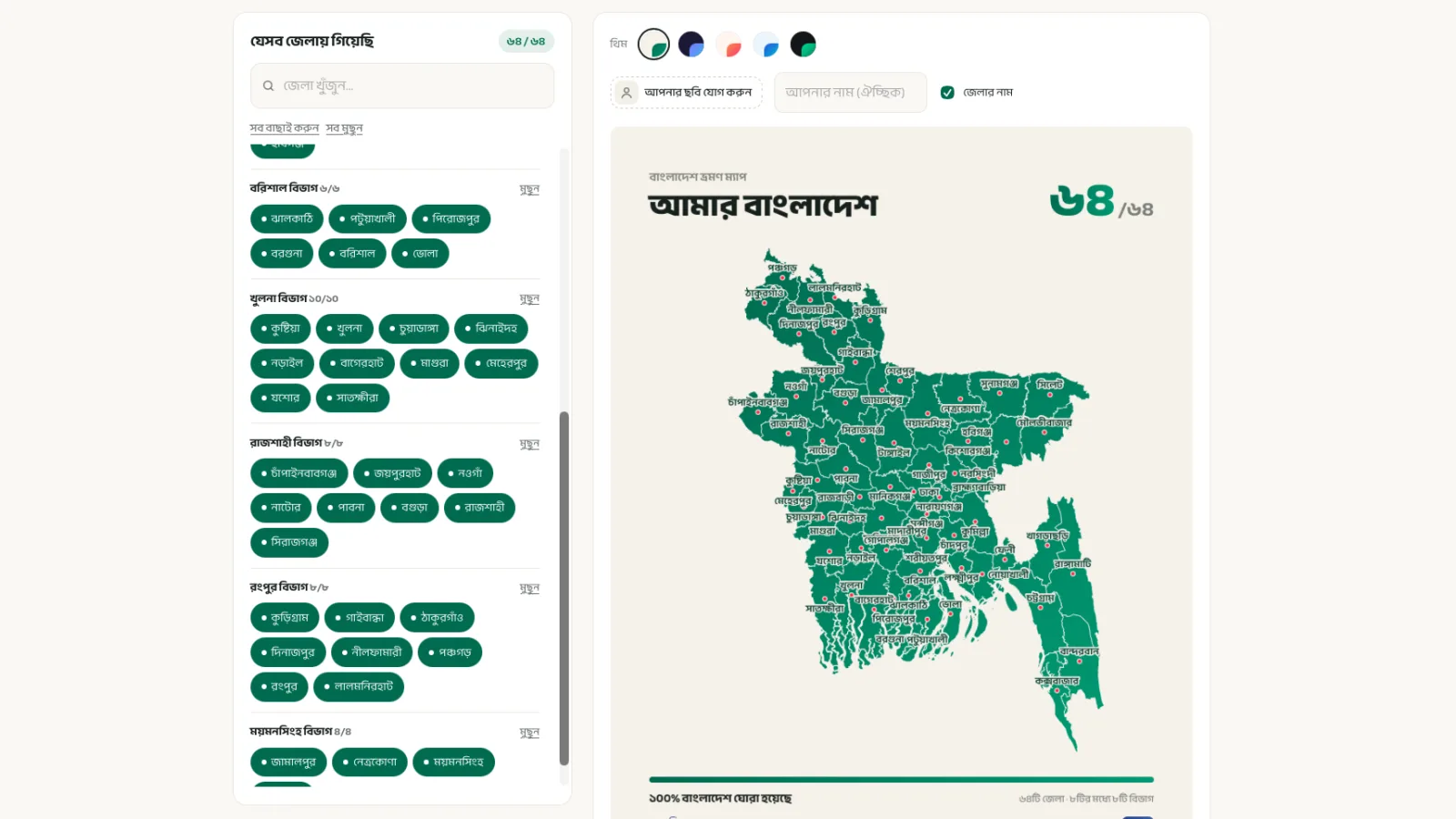
A simple interactive map that allows Bangladeshis to mark the districts they have visited has evolved into a comprehensive travel platform called Unseen Bangladesh. Created by Md. Sabbir Hossain Robin, an economics graduate from the University of Chittagong, the platform now offers district guides, trip planning, and community features to help travelers explore the country.
The map trend spread rapidly on social media, with Facebook feeds filling up with maps showing which of Bangladesh's 64 districts users have visited. Some maps were almost completely filled, while others revealed that years of traveling had barely made a dent. The trend originated from Unseen Bangladesh, which Robin initially built as a personal hobby to track his own travels.
"It started as a hobby. I could not find anything like it in Bangla, so I made one myself," Robin said. He shared his map with friends, who wanted to create their own, and the idea quickly spread. In its first week, the site attracted more than 80,000 visitors. More recently, it recorded over 2.2 million page views and 1.3 million visits in a single day.
The platform now includes a district guide covering more than 240 attractions across all 64 districts, allowing users to look up places to visit. A community feature enables local users to suggest hidden gems that may not appear in conventional travel guides, potentially bringing lesser-known destinations into the platform's database.
There is also a world map covering 195 countries, following the same concept as the Bangladesh map, allowing users to mark countries they have visited. A trivia section tests users on geography and travel-related knowledge. The trip planner helps users organize journeys by entering a starting district, selecting destinations, and setting days, budget, group size, and comfort level.
"The system then arranges the districts in the most sensible route, so you don't zigzag across the country," Robin explained. The planner adjusts itineraries based on time and budget, dropping lower-priority stops if a trip is too short or indicating how many days would be needed. Distances are calibrated against real road distances, and costs come from current transport, hotel, and food rates at three comfort levels.
Robin encountered the problem of fragmented travel information while traveling himself. A recent trip to Netrokona was particularly frustrating and pushed him to build a more comprehensive tool. The underlying information is compiled from public sources with AI assistance and then reviewed. "Keeping 64 districts' worth of information current is an ongoing job," Robin said. "I rely heavily on feedback from travelers."
The platform's rapid growth has brought challenges. At its peak, it was serving around 40,000 views every 15 minutes, causing practical problems for a project that started as a hobby. Robin moved the platform to Cloudflare, rebuilt parts to make it lighter and faster, and strengthened security.
"What moves me most is seeing people discover districts they had never thought of visiting. That is when I realised this could do something for tourism in Bangladesh," he said. Robin now wants Unseen Bangladesh to become a "trusted digital front door to tourism in Bangladesh," where travelers can discover destinations, plan routes, and understand costs.
He plans to expand beyond well-known attractions, with more guides for lesser-known destinations, an English version for foreign tourists, and further ways for travelers to suggest corrections and add places. "Tourism in Bangladesh often focuses on a handful of famous places, while every district has something worth seeing. I want to spread travelers across the whole country, so local economies in every district benefit," he said.
The platform is currently free, with no intrusive advertising or visitor tracking. Robin hopes to collaborate with the Bangladesh Tourism Board and other national tourism bodies to share official information, new destinations, and tourism campaigns. However, maintaining accurate information for all 64 districts while incorporating user suggestions remains a substantial task for a project largely run by one person.